
The Cat in the Hat: A Hero in Disguise
More than sixty years after its publication, The Cat in the Hat, published in 1957, continues to leap off bookshelves into the hearts of children. It’s often remembered for its zany rhymes, chaotic energy, and iconic visuals. But beneath the surface of all that mischief lies something deeper, something that challenges what we expect from a children’s book hero.
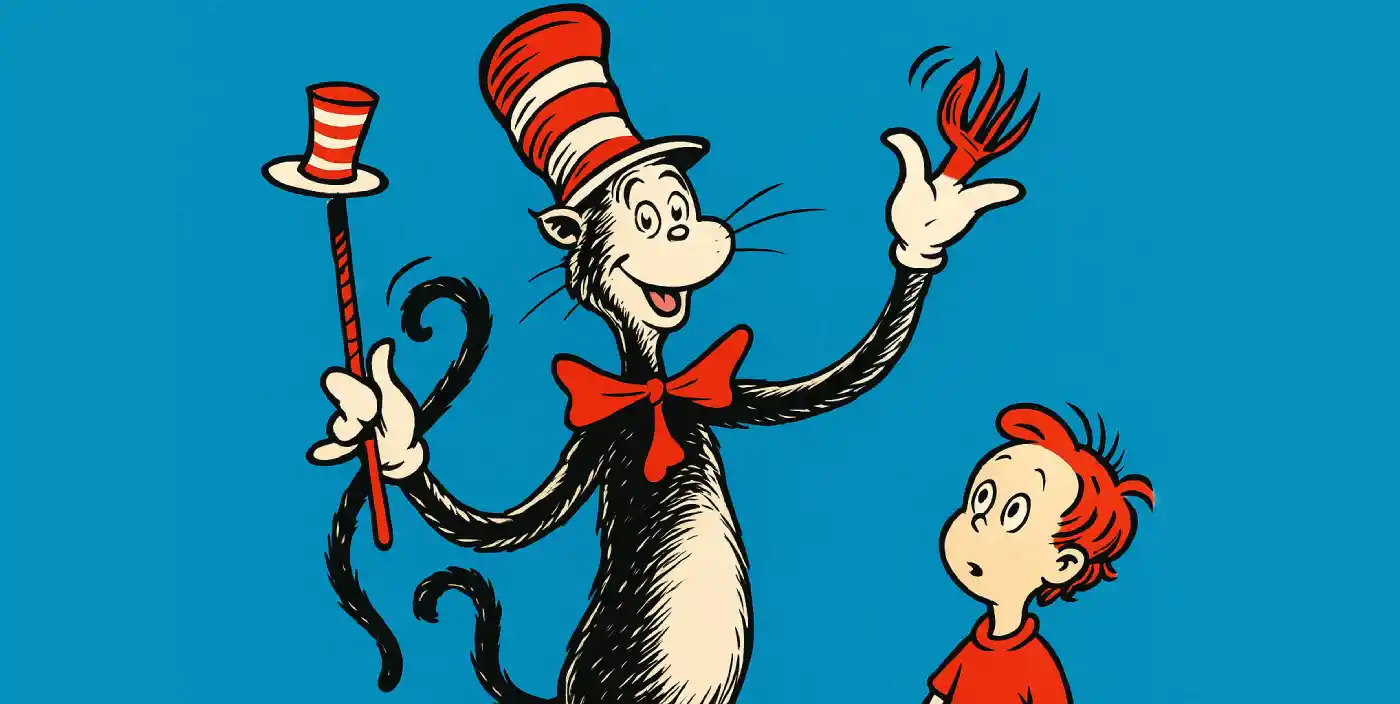
When you think of a hero in a children’s book, you probably picture a firefighter, a clever rabbit, or a curious girl. What you probably don’t picture is a tall, grinning cat in a red-and-white striped hat who shows up uninvited, turns a quiet house into a disaster zone, and never once asks permission.
And yet, in The Cat in the Hat, that’s exactly who saves the day.
A Hero in Disguise: Meet the Cat
Let’s be honest: when the Cat walks through the door, we expect things to fall apart. He’s loud, impulsive, and doesn’t ask questions. He juggles, dances, invites strange creatures into the house, and ruins almost everything in sight. For young readers, this entrance is thrilling, but also unsettling. He’s not invited, and he clearly doesn’t care.
If we saw this unfold in real life, we’d panic. The kids in the book do panic. And readers feel it, too. There’s tension bubbling beneath every rhyming line. Will the house be destroyed? Will the kids get in trouble? Why won’t the Cat just stop?
But then—just when it feels like too much—the Cat cleans everything up. Quietly. Completely. Without being asked. And leaves.
Suddenly, everything is in order again. The mess is gone. The danger has passed. And the reader is left with an entirely different feeling: Was the Cat actually… good?
A Different Kind of Hero
What makes The Cat in the Hat so bold is that it doesn’t wrap its hero in kindness or wisdom or even good behavior. The Cat breaks every rule of the house—and the rules of traditional character building. Most children’s book heroes are responsible. The Cat is not. Most are honest and direct. The Cat plays tricks. Most heroes win our trust before they win the day. The Cat wins absolutely nothing… and then fixes everything anyway.
That’s not just a narrative twist. It’s a bold invitation to rethink what a hero can look like. Maybe they aren’t perfect. Maybe they aren’t even likable at first. Maybe heroes don’t always follow the rules—but they still show up when it matters.
In a world that often tells kids to be quiet, safe, and obedient, the Cat is a wildly different message. He’s not model behavior. But he is possibility. He represents freedom. Imagination. Disruption. And ultimately—responsibility, too. Because even though he caused the mess, he took care of it. That counts for something.
Lessons in Chaos: What the Cat Really Teaches Kids
Despite his troublemaking, the Cat offers a surprising set of lessons—delivered not through preaching, but through example:
Responsibility Isn’t Always Obvious
At first, the Cat seems entirely irresponsible. But his decision to return and clean up, without being asked or thanked, suggests a hidden sense of accountability. Kids learn that doing the right thing doesn’t always come with applause—or clear explanations.
Redemption Is Possible, Even for Rule-Breakers
The Cat’s transformation from chaos-maker to problem-solver introduces children to the idea that people can change course. You can make a mess and still clean it up. You can be mischievous and still do what’s right. This nuance helps children develop empathy for characters—and people—who may not behave perfectly.
Not All Help Looks the Same
The Cat’s help doesn’t come gently. It comes after a storm of confusion. That tension is important because it introduces the idea that life isn’t always linear or predictable. Sometimes, growth and solutions arise from the least expected sources.
Psychological Impact: The Cat as a Reflection of Inner Chaos
On a deeper level, the Cat can be seen as a symbol of the children’s inner world. He doesn’t simply arrive from outside; he may represent a part of them that surfaces when no adult is around. The Cat embodies the instinct to push boundaries, to play freely, and to disrupt the order that usually surrounds them.
This makes the Cat’s return to clean up especially meaningful. It’s not just an external resolution—it’s an internal one. Through the Cat, the children face the consequences of unchecked imagination and recognize the importance of restoring balance. It suggests that exploration and play are not only natural but necessary, as long as they are followed by responsibility and care.
This blend of freedom and accountability forms one of the quietest yet most lasting lessons in children’s literature—a reminder that creativity and discipline can coexist, and that growing up doesn’t mean silencing imagination, but learning to guide it.
An Enduring Legacy in a Changing World
In a world of books where characters learn neat lessons and follow tidy arcs, this book still feels like a live wire. It lets kids experience unpredictability in a safe way. It gives them room to laugh, worry, question, and reflect—all in under a hundred rhyming lines. And most of all, it introduces the idea that heroes aren’t always who we expect them to be.
That idea matters now more than ever. As children face a world that doesn’t always make sense, books like this remind them that the “good guy” isn’t always obvious—and that mistakes don’t have to define you. That’s a lesson worth reading again and again.