
The Price of Peace
A long time ago, Greyvale made a deal.
The people were tired of sorrow. So, when the Crow of Dusk came offering peace and silence, they accepted. In return, they gave him time. Every hundred years, when the moon hangs lowest in the sky and the air grows cold without warning, the village of Greyvale falls asleep.
Each century, one was spared — chosen to solve the riddles that would lift the sleep for another hundred years. The village simply slept, and the child awoke to buy the village another century of peace.
This time, it was Venus.
She wasn’t the bravest child in Greyvale. Nor the smartest. But she remembered everything. Her
grandmother used to say, “Memory is the sharpest kind of blade, child. Never let yours rust.” Maybe that’s why Venus was chosen.
The village square was quiet as bone.
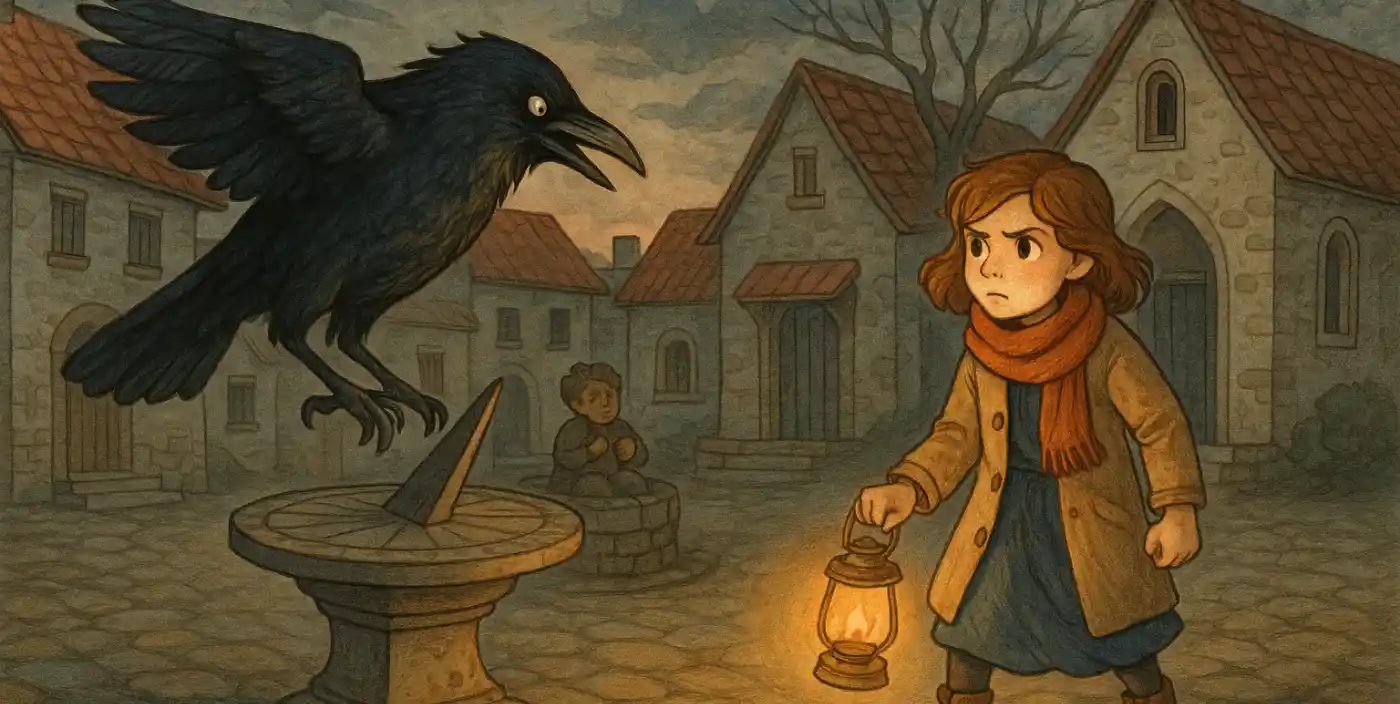
Venus stood alone. Her wool scarf clutched at her neck like a nervous cat. Her best friend, Tomas, sat mid-laugh on the edge of the well, a raisin bun halfway to his mouth. His eyes stared right through
her.
A wind stirred — but no leaves rustled. And then… the crow came.
It dropped from the sky like a shadow breaking loose from the clouds. Feathers slick as ink, eyes like mercury.
It landed on the sundial and lifted one wing and spoke:
“I’m tall when I’m young, and short when I’m old. What am I?”
Venus let out a breath. That one was simple. “A candle.”
The crow’s wings rufled slightly. “Good,” it said, though its voice carried no joy. “Find it, then.” She knew what it meant. The Eternal Lantern, always burning in the chapel’s alcove.
Then it vanished, as if swallowed by the shadow of its own wings, turning into a gust of feathers and ash.
Inside the chapel, Venus held the lantern steady. Its glow cast long shadows on the stone floor. On the altar sat a parchment tied with a frayed red string. Hands shaking, she opened it.
“The more you take, the more you leave behind. What am I?”
“Footsteps,” she whispered, thinking of the muddy field. The lantern flickered. A hidden stairway opened.
Heart pounding, Venus stepped into the dark.
The tunnel under the chapel smelled like wet earth and old stone. Somewhere above, water was dripping – slow drops that echoed in the silence. At the end, there was a heavy wooden door, carved with moons and feathers, cracked and worn like everything else in Greyvale.
On the door was a riddle, carved deep into the wood:
“I have hands, but I cannot clap.”
Venus felt a small smile even though her stomach was twisting cold. “A clock,” she said.
The door moved open with a low groan.
Inside was a tiny room. In the middle stood a tall mirror, the glass foggy and clouded. Her reflection looked weird—like a shadow, blurry and far away. Then a voice spoke.
“One last riddle,” it said.
“What belongs to you, but others use it more than you do?”
Venus didn’t have to think. “My name.”
The mirror cracked, a thin line spider-webbing across the glass. Behind the broken glass was a small stand. On it was a silver pocket watch, its hands spinning wild.
Venus reached out but stopped.
The Crow of Dusk was there now, its wings folded tight.
“You’re almost done,” it said. “But the deal isn’t finished. You must give up one memory. One. And once it’s gone, it’s gone for good.”
Venus’s fists clenched tight. “What kind of memory?”
The crow’s eyes glinted like cold steel.
“One that means the most to you. It will disappear from you forever.”
Venus shut her eyes and felt all the memories press in. Faces she loved. Moments she held close. Each one felt like a thread holding her together.
Then one came—clear as day. The night she was five and sick, wrapped in blankets. Her mother’s hand on her forehead, humming a lullaby. The last time she could remember her mother’s voice.
Venus’s eyes filled with tears. That memory was a piece of her heart. Could she really let it go?
She thought of Tomas’s smile frozen forever, the orchard heavy with apples, the village bell ringing in the morning.
If she lost the wrong memory, she might lose herself.
But she knew she had to.
With a shaky breath, she whispered, “Take that night—the lullaby.”
Something cold rushed through her chest. The memory slipped away like mist. She couldn’t even picture her mother’s voice anymore , and a hollow ache settled deep inside.
The crow nodded.
The pocket watch clicked.
Suddenly, the ground trembled beneath her boots, a low groan rising from the stone like the village itself was waking from a bad dream. Dust rained down from the ceiling. The mirror shattered, splintering into a thousand gleaming fragments that vanished before they touched the floor.
The pocket watch in Venus’s hand let out one last, slow tick... then stopped. Its hands froze at midnight.
A crack opened beneath her feet. Venus staggered back as the walls rippled like curtains in wind, the tunnel collapsing into silence behind her.
And then—she was no longer in the dark. She blinked hard.
She stood in the center of Greyvale’s square.
The sky blushed. Tomas gasped, the raisin bun slipping from his hand. Tomas blinked beside the well, the raisin bun falling from his hand.
Around her, the village stirred. People emerged from their doorways, rubbing their eyes. No one remembered the sleep.
No one remembered the crow.
She clutched the watch tightly in her palm. It was cold now. Ordinary. And yet, she had saved them.
She had bought them another hundred years of peace.
The bell tower rang, its chime soaring into the morning sky.
Venus didn’t cry. She stood tall, her shadow stretching long and certain beneath the morning sun. Peace had returned to Greyvale.
But only she knew what it had cost.
In Conversation with
the author
What inspired you to write The Price of Peace?
I wanted to explore what people are willing to give up to end conflict. Not a perfect peace, but the kind that comes after loss and tough choices. That idea stuck with me—and became the heart of the story.
How did you get into creative writing?
I started writing when I was around 8 years old. I was reading a lot back then, and at some point, I just wanted to create stories of my own. Since then, for the past 4 years, I’ve just kept writing what I’d want to read.
Who are your favorite authors, and why?
Holly Jackson is my top favorite—her plots are so smart and twisty, and I love how she writes teenage characters that actually feel real. Ross Welford is another one I enjoy—his books are full of imagination but still hit you emotionally. And Lena Jones has this gritty style I really like; her mysteries are dark but super clever. I always feel inspired to write after reading their books.
If you could give one piece of advice to aspiring writers, what would it be?
Don’t overthink the first draft. Just get your ideas down—you can always shape it later. Writing improves by writing.
Anything else you'd like to share about your writing journey?
Writing has always been something I turn to—it’s my way of thinking things through, expressing emotions, or just escaping into another world for a while. Sometimes it helps me figure out what I’m really feeling. It’s not just a hobby for me, it’s something I genuinely need in my life.